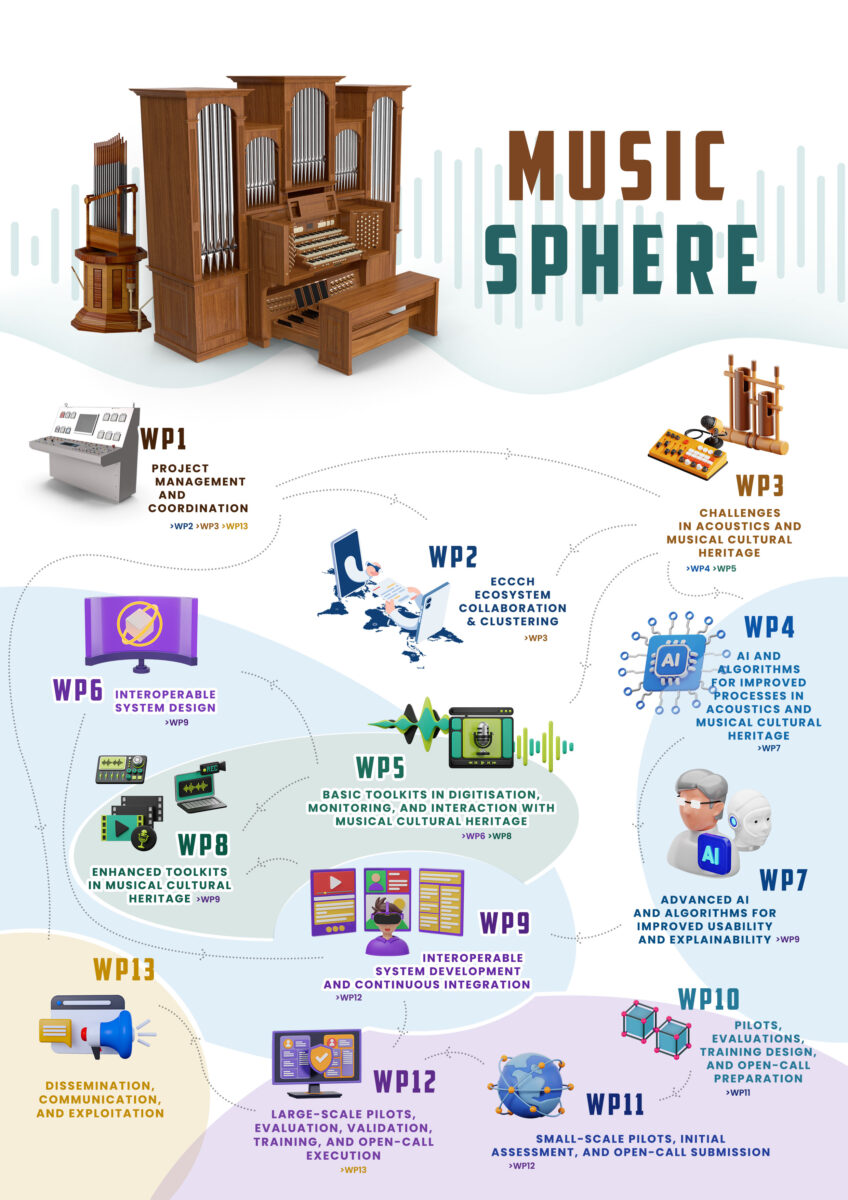
Work Packages
WP1. Project management and coordination
The focal point of WP1 is to provide overall project leadership and management to ensure the consortium partners are aligned with the project goals and the work plan is being implemented as outlined. To achieve this, WP1 will pursue the following objectives: (1) To provide efficient overall project management throughout the project’s duration; (2) to coordinate the external project advisory boards; (3) to define and apply the procedures required to ensure high quality project outcome and to mitigate risks; (4) to define and implement the project’s open science practices and data management plan; and (5) to define intrinsic legal, ethical and societal issues relevant for the project.
WP2. ECCCH ecosystem collaboration and clustering
The main objective of WP2 is to establish close, strong, and continuous collaboration of MusicSphere with other EU-funded projects under the ECCCH-2023 and ECCCH-2024 calls, for working on common ground, early knowledge exchange, and adoption of best practices, methods, and tools (SO7).
WP3. Challenges in acoustics and musical cultural heritage
The main objective of WP3 is to analyse the state-of-the-art and define the future trends in a broad spectrum of scientific fields that are relevant to acoustics and musical cultural heritage, through innovative tools for digitisation and analysis of dynamic processes, objects and complex combined, as well as the trends of new and immersive technologies, obtaining as outputs as set of requirements, guidelines and, at the end, a framework that will support the methodology in the rest of WP, that covers how to integrate the novel technologies proposed in the project.
WP4. AI and algorithms for improved processes in acoustics and musical cultural heritage
The main objective of WP4 is to develop and adopt artificial intelligence and algorithms for digitisation and analysis of dynamic processes, objects and complex combined data in acoustic and musical cultural heritage. This WP represents the initial phase of AI and algorithms that will be integrated in the basic toolkits and the interoperable platform for the small-scale pilots.
WP5. Basic toolkits in digitisation, monitoring, and interaction with musical cultural heritage
The main objective of WP5 is to develop foundational tools and technologies for the effective digitization, monitoring, and interaction with musical cultural heritage artifacts. This includes creating baseline systems for capturing, analysing, and preserving acoustic and material characteristics, ensuring compatibility with other systems, and supporting further advancements in monitoring and interaction technologies. These tools aim to enable reliable documentation, preservation, and accessibility of musical heritage for research and public engagement.
WP6. Interoperable system design
The main objective of WP6 is to deploy the appropriate tools for the development of the interoperable human-centred, centralised and innovative web-based platform that will host the empowered by AI toolkits and methods for digitisation and analysis of dynamic processes, objects and complex combined data of musical CH, in complete alignment with the ECCCH recommendations, based on the holistic framework of the MusicSphere project.
WP7. Advanced AI and algorithms for improved usability and explainability
The main objective of WP7 is to further develop and adopt artificial intelligence and algorithms for digitisation and analysis of dynamic processes, objects and complex combined data in acoustic and musical cultural heritage. This WP represents the final phase of AI and algorithms that will be integrated in the final toolkits and the interoperable platform for the large scale pilots, as well as for the ECCCH.
WP8. Enhanced toolkits in musical cultural heritage
The main objective of WP8 is to further improve the toolkits and methodologies of WP5 that will include the progress of WP7 regarding acoustics and musical cultural heritage.
WP9. Interoperable system development and continuous integration
The main objective of WP9 is the further development of the interoperable web-based platform that will host the empowered by AI, toolkits, and methods, in a complete alignment with the ECHOES project infrastructure, libraries, and recommendations, for digitisation and analysis of dynamic processes, objects and complex combined data of acoustics and musical cultural heritage.
WP10. Pilots, evaluations, training design, and open-call preparation
The main objective of WP10 is to prepare the two phases of the test pilots (small and large scale), to design the training activities and plan the recruitment stakeholders and CH professionals for the innovative solutions of the project, and to define the procedures regarding the announcement, submission, evaluation, selection and timeline for the open call to third parties (SO8).
WP11. Work package title Small-scale pilots, initial assessment, and open-call submission
The main objective of WP11 is to execute the small scale pilots, to setup the training activities and recruit stakeholders and CH professionals for the innovative solutions of the project, and to announce, receive, evaluate, and select the third party funded projects through the open call (SO8).
WP12. Large-scale pilots, evaluation, validation, training, and open-call execution
The main objective of WP12 is to execute the large scale pilots, to train stakeholders and CH professionals in the innovative solutions of the project, and to complete harmonically the support to the third party funded projects through the open call (SO8).
WP13. Dissemination, communication, and exploitation
The main objective of WP13 is to maximise the impact of the project by (a) ensuring maximum visibility and public awareness of the project aims, progress and results to all relevant stakeholders across the EU and the rest of the world, and (b) enabling the transformation of research innovations and prototypes into sustainable solutions with economic value and societal benefits (SO8).